
Based on true events. Some names and details have been changed, but the fear was real. In 2014, a family in New Jersey bought their dream home and before they could move in, they began receiving letters from a stranger who called themselves “The Watcher.” This is the watcher horror story that started it all — a fictionalized retelling of real events, imagined with new characters, new twists, and one question that still lingers: what do you do when your home is watching you back?
The first letter came on a Tuesday, three days before the Hartley family even moved in.
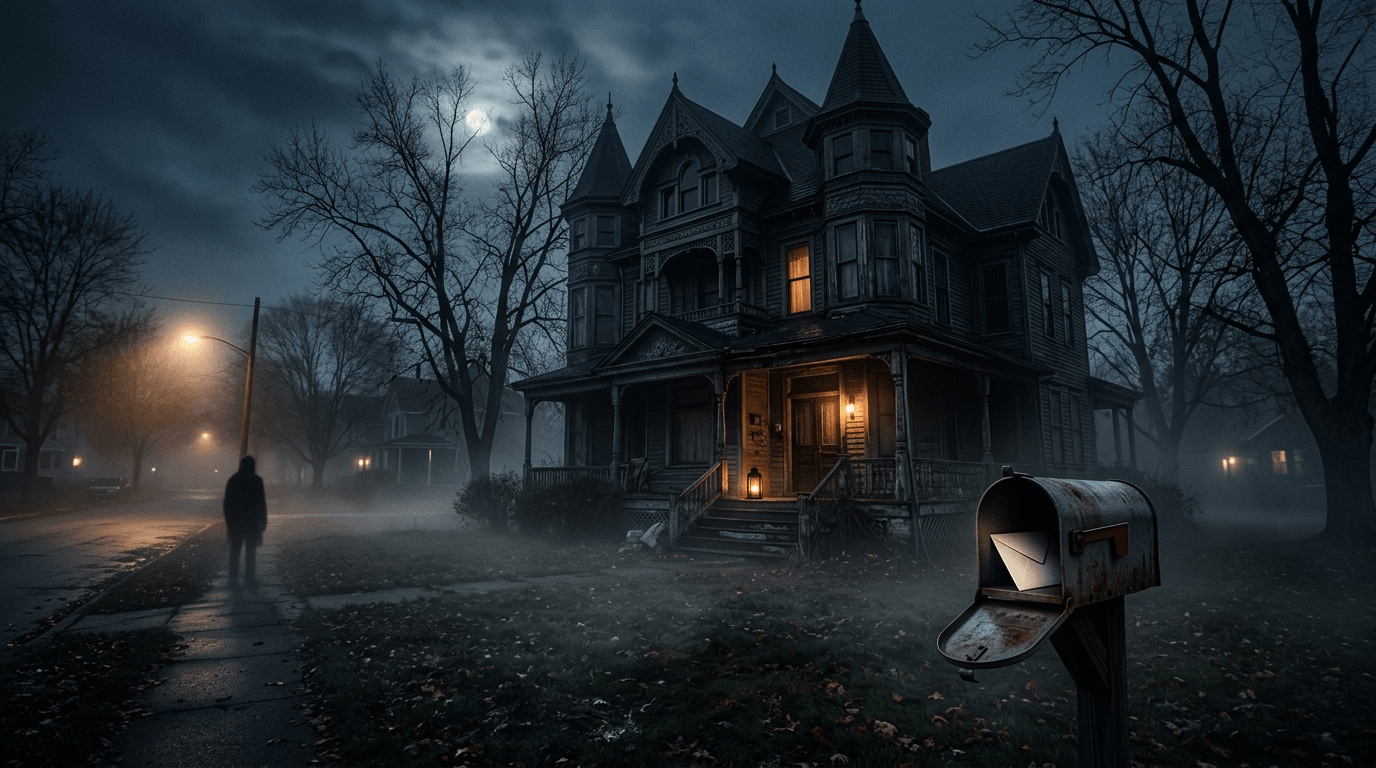
David Hartley found it in the mailbox of 657 Boulevard, the big old house he and his wife Claire had just bought in Westfield, New Jersey. It was still empty. No furniture. No boxes. Just bare wood floors and the smell of fresh paint. So when he saw a white envelope sitting inside the mailbox, he felt a small twist in his stomach. Nobody knew they were moving in yet. Or so he thought.
He opened it standing right there on the porch, the October wind pulling at the paper in his hands.
Welcome to 657 Boulevard, it began. I have been watching this house for a very long time. My family has watched it for generations. Now it is my turn. Do you know what lies within its walls?
It was signed, simply, The Watcher.
David laughed at first. He showed it to Claire that night and said it was probably some bored teenager from the neighborhood having fun. Claire didn’t laugh. She read it twice, then a third time, her eyes stopping on one line near the bottom.
You have children. Young blood always excites me.
“David,” she said quietly, “we have three kids.”
They had two daughters and a son. Emma was twelve, sharp and watchful like her mother. Liam was nine, always asking questions. And little Sophie was six, too young to understand any of this yet, which was, in a strange way, the only comfort Claire had.
The second letter came a week later, right after they moved their furniture in.
Why are you here? I will find out. Who has the master bedroom? Who has the second floor? I need to know because I need to plan.
This one felt different. It wasn’t just spooky. It knew things. It knew which room Emma had picked, the one facing the street. It knew Liam had asked his father to paint his room blue. Nobody outside the family should have known that.
David called the police that same afternoon. Officer Ramirez came out, walked the property, took photos of the letters, and asked the usual questions. Had they made any enemies? Did they know anyone who might do this as a prank? David shook his head each time. They had barely lived in this town for two weeks.
“Some people don’t like new families moving in,” Ramirez said, folding his notebook shut. “Especially into a house like this. Big, old, expensive. Somebody might be jealous. Try not to worry too much.”
But David did worry. He noticed it in small things after that, a curtain across the street that seemed to move when he stepped outside, a car parked a little too long at the end of the block, the way the porch light sometimes flickered even though the bulb was brand new.
Across the street lived a British girl named Charlotte, seventeen, who had grown up in that neighborhood her whole life. One afternoon, while Claire was unpacking boxes in the yard, Charlotte walked over, arms crossed against the cold.
“You got a letter too, didn’t you,” Charlotte said. It wasn’t really a question.
Claire straightened up. “How do you know that?”
“Because the family before you got them. And the family before them.” Charlotte glanced at the house like it might be listening. “Nobody stays here long. There’s stories about this place. Old stories. People say there’s something hidden inside the walls — like a tunnel, or a room nobody’s found yet.”
That night, David couldn’t sleep. He sat in the kitchen with a flashlight and a hammer, tapping gently along sections of wall, listening for anything hollow. Claire found him at two in the morning, kneeling by the fireplace, sweat on his forehead despite the cold house.
“You’re scaring yourself,” she whispered.
“Somebody is scaring us,” he said. “I just want to know who.”
The Letters Escalate
Three weeks passed. Letters kept arriving, each one worse than the last.
I heard the little one crying last night. Is she afraid of me? She should be.
That line broke something in Claire. She packed the kids into the car that same night and drove them to her sister’s house two towns over, refusing to bring them back until this was solved.
David hired a private investigator, a quiet man named Tom Whitfield who had worked in the area for over twenty years. Whitfield studied the letters for handwriting patterns, checked the postmarks, even suggested hidden cameras around the property. Weeks went by with nothing. No prints. No pattern in the mailing times. Nothing on any camera except the mail carrier and the occasional dog walker.
Then something odd happened. A teenage boy named Kenji, who lived two houses down and had recently moved from Osaka with his family, came to David one evening holding his skateboard under one arm.
“I think I saw someone,” Kenji said carefully, his English good but a little hesitant. “Late at night. Standing near your mailbox. Maybe two, three weeks ago. I thought it was you, checking mail. But it was too late for that. Almost one in the morning.”
“What did they look like?”
Kenji shook his head. “Dark jacket. Hood up. I didn’t think much of it then.” He paused. “But now I keep thinking about it.”
David wanted to press further, but Kenji had nothing more to offer. Just a shape in the dark, gone before anyone could really see it.
The Watcher Horror Story’s Final Letters
By December, the Hartleys still hadn’t fully moved back in. They kept the house, paid the bills, mowed the lawn, but they slept at Claire’s sister’s place most nights. The letters kept coming anyway, as if The Watcher didn’t care whether they were home or not.
You think leaving will stop me. It won’t. This house belongs to me. It always has.
One night, David decided he’d had enough. He would stay the night alone in the house, hidden in the dark, waiting. Claire begged him not to. He went anyway, sitting in the living room with only the moonlight from the window and his old baseball bat resting across his knees.
Around midnight, he heard it — a soft crunch of gravel outside. Footsteps. Slow. Careful.
His heart pounded so loud he thought it might give him away. He crept toward the window and looked out through the gap in the curtain.
There, standing near the mailbox under the streetlight, was a figure in a long coat.
David didn’t think. He ran. He threw open the front door and sprinted across the lawn, shouting. The figure turned, startled, and bolted down the street. David chased for almost a block before the figure disappeared between two houses, gone into the dark like smoke.
When he caught his breath and turned back, something on the ground near the mailbox caught his eye. A folded piece of paper, dropped in the panic.
He picked it up with shaking hands. But it wasn’t a new letter. It was an old one — one of the earlier ones sent to the family who had lived there before the Hartleys. Someone had been carrying it. Studying it. Comparing it, maybe, to a new one they were about to write.
The final letter arrived two days later, and it was the last one the Hartleys ever received.
You saw me. That was foolish. But it doesn’t matter now. I don’t need to hide anymore, because I’ve already won. You will never live in this house. None of you ever will.
David brought it straight to Officer Ramirez, along with the dropped letter from the earlier family. Ramirez studied both for a long moment, his face changing from mild interest to something more serious.
“This handwriting,” he said slowly, “matches a name we looked at years ago. Somebody who lived on this street long before your house was even built the way it is now. Family obsessed with the place. Never got over losing it in some old property dispute, way back.”
They pulled old town records. There had been a legal fight decades earlier, before David or Claire were even born, over who truly owned the land at 657 Boulevard. The losing family had never let it go. Their descendants had apparently kept watching, kept writing, generation after generation, treating the house like something stolen from them.
But here was the twist nobody expected: when investigators finally tracked down a living relative of that old family, an elderly woman in her eighties, she had no memory of writing anything. Dementia had taken most of her sharper years. Her son, questioned separately, broke down and admitted the truth. It was him. He had grown up hearing his mother’s bitter stories about the house that should have been theirs. Somewhere along the way, that old family bitterness had turned into something darker inside him, not supernatural, not a hidden room in the walls, nothing that spooky at all. Just a grown man who never let go of an old grudge, watching strangers live inside a house he believed, wrongly, belonged to his blood.
There were no secret tunnels. No trapdoors. No ghost walking the halls at night. Just an ordinary man standing in the dark outside an ordinary house, writing letters meant to make a family afraid enough to leave.
The Hartleys sold 657 Boulevard within the year. They never told the new owners everything. Some things, David decided, were better left in the past.
But sometimes, even in their new home three towns away, Claire would wake in the middle of the night, certain she’d heard footsteps on gravel outside. She would lie there in the dark, listening, waiting for a sound that never came again.
Almost never.
If cases like this stay with you, you’ll find more true horror stories on Dark Hour Stories, including real haunted places with histories just as strange.