
The bell rang at midnight, and by sunrise, someone in Millbrook was dead.
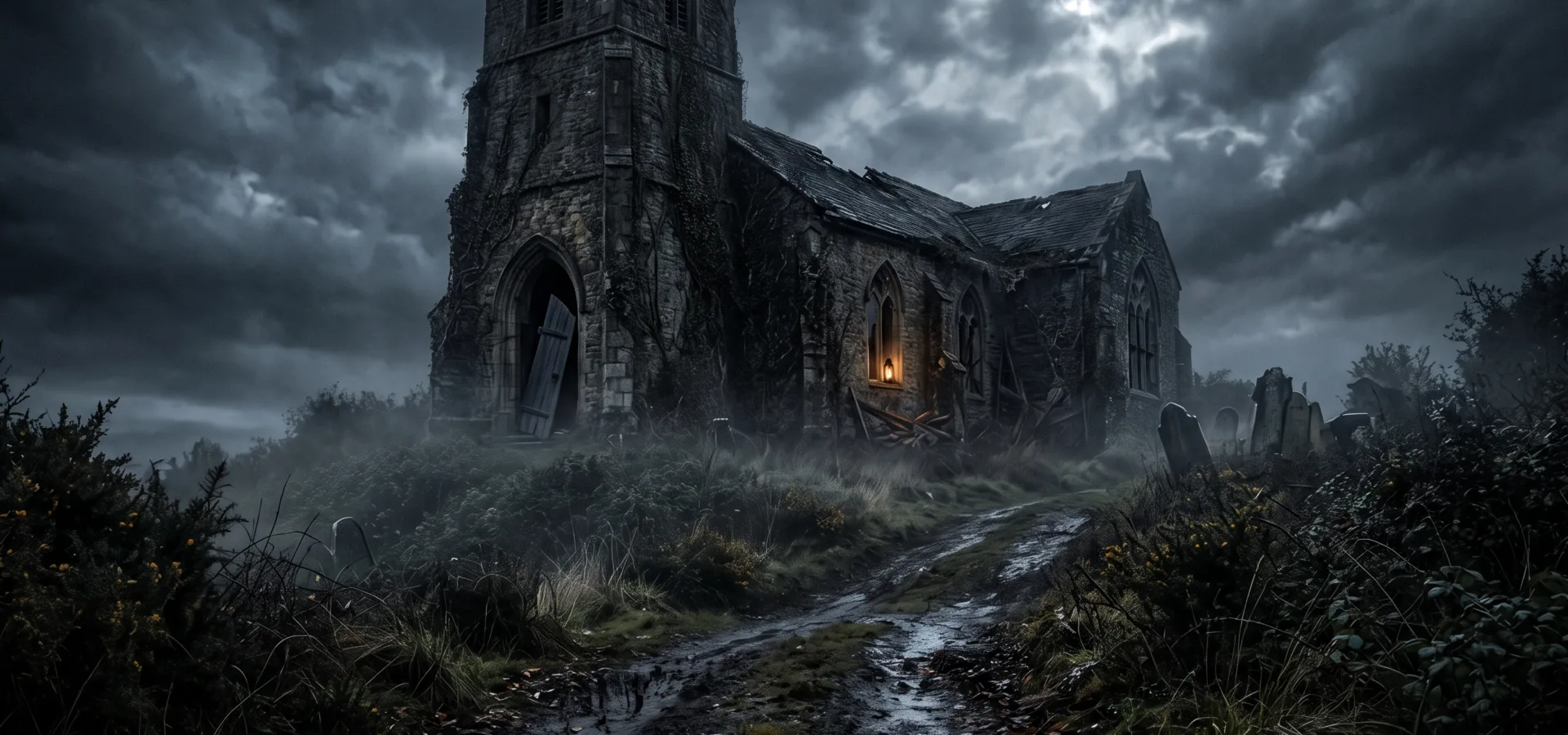
That was the story everyone in the valley knew. Nobody could explain it, but nobody questioned it either. It was the kind of church bell horror story every village nearby had heard at least once, usually with a shrug. The old church sat on a hill outside the village, its wooden doors rotted shut, its windows broken by wind and time. No priest had lived there in fifty years. Yet somehow, before every death in Millbrook, the bell rang. Once. Just once. And then, silence again.
Haruto Sato didn’t believe in any of it.
He was a journalist from Tokyo, twenty-six years old, sent by his magazine to write a piece on “strange rural legends of the English countryside.” His editor thought it would be a fun, harmless story. Something readers could laugh at over coffee. Haruto thought it would be a waste of his time. He had covered real news before — corruption, disasters, court cases. A bell that rang by itself felt beneath him.
But his flight was booked, and the story was due in two weeks, so on a Tuesday afternoon, he took the taxi and reached the Millbrook, somewhere in the hills of Yorkshire.
The village looked smaller than he expected. A row of stone cottages. A closed small bar with peeling paint. A red phone box with no phone inside. The streets were empty, and the sky was heavy with clouds that hadn’t decided if they wanted to rain.
He knocked on the first cottage door he saw. An old woman answered, her eyes pale blue, almost gray. She didn’t seem surprised to see him.
“You’re here about the bell,” she said. It wasn’t a question.
“I am. I’m a journalist. My name is Haruto.” He held out his hand. She looked at it but didn’t take it.
“Emily Whitmore,” she said. “You won’t find what you’re looking for here, love. But you’re welcome to look.”
She let him in anyway. Her cottage smelled like old wood and tea leaves. She told him the story slowly, the way people tell stories they’ve told a hundred times before. The church, she said, was built almost two hundred years ago. It used to be the heart of Millbrook — weddings, christenings, Sunday mornings full of singing. But something happened there. She wouldn’t say what. She only said the bell started ringing on its own after that, always the night before someone in the village died.
“When did it last ring?” Haruto asked, pen ready over his notebook.
Emily’s hands trembled slightly as she poured the tea. “Three nights ago. Old Mr. Pierce passed the next morning. In his sleep. Heart, they said.”
Haruto wrote it down, though he didn’t believe a word.
Voices of Millbrook: The Church Bell Horror Story Unfolds
Over the next two days, Haruto spoke to almost everyone left in Millbrook — and there weren’t many. An old fisherman named Thomas Reed, who fished a river that Haruto never actually saw any fish in. A boy named Jack Ashworth, maybe sixteen, who rode his bicycle in circles around the empty village square like he had nowhere else to be. A woman named Sakura Lin, who ran what used to be the village shop but now just sat behind an empty counter with a cup of cold coffee.
They all told him the same story, almost word for word. The bell. The ringing. The death that followed. Nobody could explain why. Nobody wanted to.
What struck Haruto wasn’t the story itself — it was how calm everyone seemed while telling it. As if a self-ringing death bell was just another part of daily life, like the weather or the mail.
On his second night, curiosity got the better of him. He decided to walk up to the church after dark. Not because he believed the legend, but because good journalism needed a strong scene, and an old creepy church at midnight would make his editor happy.
The path up the hill was steep and covered in wet leaves. His flashlight cut a thin, shaking line through the dark. The wind picked up as he climbed, pushing against him like it didn’t want him to go further. When he finally reached the top, the church stood in front of him, black against a blacker sky. Its bell tower rose above the broken roof like something that refused to fall down, no matter how much time tried to make it.
He pushed the door. It groaned open.
Inside, dust everywhere, a cracked stone floor. Cobwebs hung like curtains between the wooden beams. His flashlight beam shook slightly as he walked further in, though he told himself it was just the cold making his hands unsteady, not fear.
At the back of the church, a narrow staircase spiraled up toward the bell tower. Haruto climbed it slowly, each step creaking under his weight.
At the top, the bell hung silent, thick with rust and dust. He touched it. Cold. Solid. Ordinary.
“See,” he whispered to himself. “Just a bell.”
Twelve Rings
Then, at exactly 3:14 in the morning, it rang.
Not once.
Twelve times.
The sound was deep and hollow, shaking the tower, shaking his chest, shaking something deep inside him that he didn’t know could be shaken. He stumbled back down the stairs, heart pounding, and ran out of the church into the freezing night air, gasping as he’d been underwater.
He ran straight to Emily Whitmore’s cottage and banged on her door until she opened it, wrapped in a shawl, her face unreadable in the moonlight.
“It rang,” Haruto said, breathless. “Twelve times. But everyone’s still alive — I just saw the lights on in the cottages, I saw Jack riding his bike an hour ago —”
Emily looked at him for a long moment. Something in her expression changed. Not fear exactly. More like pity.
“Twelve times,” she repeated softly. “That’s never happened before.”
“What does it mean?”
She didn’t answer right away. Instead, she stepped aside and let him in, sat him down, and poured him tea with hands that trembled more than before.
“The bell doesn’t ring for people who are about to die, Haruto,” she said finally. “It rings for people who are about to *understand*.”
“Understand what?”
Emily’s eyes filled with something close to tears. “Millbrook died forty years ago, love. All of us. There was a fire — the old chemical plant by the river, back when this was still a working village. It happened fast. Nobody got out. Not Thomas, not Jack, not Sakura. Not me.”
Haruto laughed, a short, sharp, nervous sound. “That’s not — that’s impossible. I’ve spoken to all of you. I shook your hand. I drank your tea.”
“Did you?” Emily asked quietly. “Or did you only think you did?”
Haruto looked down at the teacup in his hands. It was empty. It had always been empty. He hadn’t noticed until now.
He ran outside into the square, and for the first time, he really looked — truly looked — at Millbrook. The cottages he had knocked on, the shop Sakura sat in, the river Thomas fished — none of it had roofs that fully stood, none of it had doors that fully closed, none of it had colors that weren’t fading into gray. The red phone box wasn’t red at all. It was rust, curling in on itself like a dying flower. He had seen what he expected to see, not what was actually there. His mind had filled in the gaps the way it always does when we want something to make sense.
The village hadn’t looked empty because everyone was hiding indoors. It had looked empty because there was no one left to fill it, except for the ones who never truly left.
Jack Ashworth appeared at the end of the street, still riding his bicycle in slow, endless circles, his eyes fixed somewhere Haruto couldn’t see. Sakura Lin stood in the doorway of her shop, watching him with the same sad, patient expression Emily wore.
“The bell rings twelve times for someone crossing over,” Emily said, appearing beside him without a sound. “For someone who wandered too far into a place that isn’t theirs anymore. It’s not a warning of death, Haruto. It’s a warning that you’re already standing where the dead remain.”
Haruto’s editor never received his article. Three weeks later, a search team found his rented car parked at the bottom of the hill outside a village called Millbrook — a village, records showed, that had been abandoned since a fire destroyed it in 1984, with no survivors.
They never found Haruto.
But on quiet nights, hikers passing near the old church sometimes report seeing a young man standing beneath the bell tower, notebook in hand, still trying to finish a story that ended long before he ever arrived — and still waiting, patiently, for someone to explain to him how he got there.
If this kind of story stays with you, you’ll find more true horror stories on Dark Hour Stories — including real haunted places that inspired chilling tales just like this one