
The Island of the Dolls True Story Begins
“Based on true events, this story recounts Julián Santana Barrera’s discovery of a drowned girl in Xochimilco and the decades he spent hanging dolls in her memory.”
This is the real Island of the Dolls true story — not the ghost-tour version tourists hear today, but what actually happened to Julián Santana Barrera in the canals of Xochimilco.
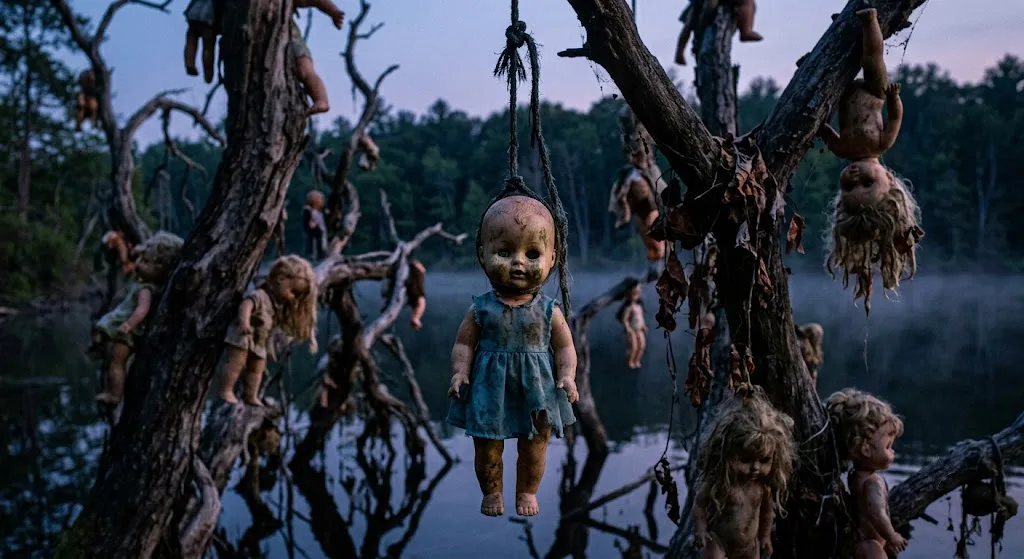
The island wasn’t always like this. That’s what people don’t understand when they visit now, cameras in hand, snapping photos of the rotting dolls hanging from the trees like a forest of the damned. They see the horror and assume it was always there. But Julián Santana Barrera knew the truth. The island was peaceful once. Quiet.
He’d left everything in the 1950s—his wife, his family, the noise and chaos of Mexico City—to live alone in Xochimilco. Just him, the canals, and the chinampas he cultivated. He was a simple man, religious, content with solitude and soil under his fingernails. For years, this was enough.
Then came the day that changed everything.
Julián was fishing in the early morning when he saw her. At first, he thought it was debris—a pale shape caught in the reeds. But as he drew closer, his breath caught. It was a girl. Small. Young. Her body had been in the water long enough that he couldn’t tell how long. Couldn’t tell who she was. Couldn’t tell anything except that she was dead, and she was his burden now.
Beside her, tangled in the weeds, was a doll. Waterlogged. One eye hanging loose. He pulled both from the water—the girl first, gently, as if she were still alive—and the doll second, almost without thinking.
He buried the girl himself. Alone. No ceremony, no priest. Just Julián, a grave, and the weight of having found something he was never meant to find.
That night, he couldn’t sleep.
It wasn’t guilt exactly. It was something else. A presence. A wrongness that clung to the air like humidity before a storm. He lay in his small house and heard things—sounds that didn’t belong. Whispers. Footsteps on his porch. The feeling of being watched from the darkness beyond his window.
And then, at the worst hours, he heard a child crying.
The doll sat on his table. Waterlogged. Broken. Staring at him with that one hanging eye. And somehow, Julián became convinced that the girl—the drowned girl—was still here. Still on the island. Still suffering. Still wanting something from him.
He didn’t know why he hung the doll in the tree. Maybe desperation. Maybe madness already creeping in. Maybe he truly believed that the doll would comfort her restless spirit, would give her something familiar to cling to in whatever dark place she now inhabited.
But it didn’t stop the crying.
So he collected more dolls. From the trash heaps of Mexico City. From the canals. From anywhere he could find them—broken, one-eyed, dismembered, forgotten. He hung them in the trees. He nailed them to branches. He scattered them across his island like offerings to a god he couldn’t name.
The Legend Spreads
Years passed. Decades.
People began to notice. Tourists came. Stories spread. In 2022, the island earned an unlikely honor: Guinness World Records recognized it as home to the world’s largest collection of haunted dolls. The Island of the Dolls became famous, a dark curiosity, a place for thrill-seekers and paranormal investigators. They said the dolls were possessed. They said the island was haunted. They said Julián was mad.
But Julián knew the truth. The island wasn’t haunted by the dolls.
The dolls were there because the island was haunted by the girl.
He could still hear her sometimes, especially at night. Still feel her presence, cold and desperate, moving through the shadows between the trees. Still sense her anger—not at him, but at being forgotten. At being drowned. At lying in an unmarked grave while the world moved on.
The dolls were his penance. His obsession. His way of saying: *I remember you. You’re not alone. I see you.
But they never stopped her crying.
Julián’s Final Night
In 2001, fifty years after he’d pulled her body from the water, Julián Santana Barrera was found dead. In the canal. In the exact spot where he’d discovered the girl all those years ago.
They said it was an accident. That he’d fallen while collecting more dolls. That he’d drowned, just like she had.
But the people who knew him—the few who’d spoken to him over the decades—said something else. They said he’d finally gone to join her. That whatever haunted the island had finally called him home. That perhaps, in the end, he hadn’t been trying to appease her spirit at all.
Perhaps he’d been trying to follow it.
The dolls remain. Thousands of them now, hanging from every tree, nailed to every surface, a sprawling monument to grief and obsession and a mystery that will never fully be solved. Tourists still visit. They take selfies. They laugh nervously. They say the place is creepy.
But if you listen closely—really listen, in the deep quiet of the island when no one else is around—you might hear what Julián heard for fifty years.
A child crying.
Still waiting.
Still hungry.
Still there.