
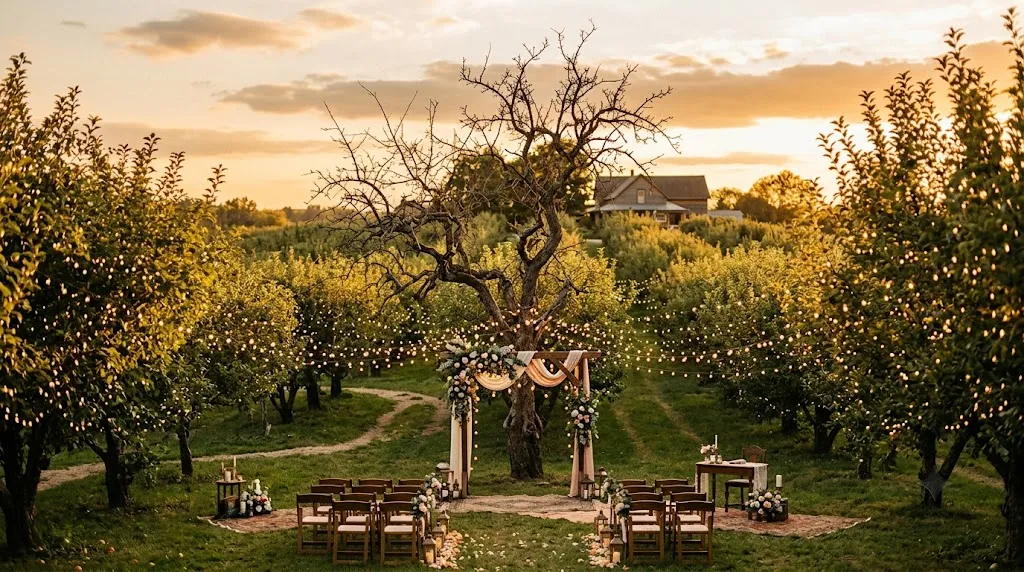
Not every happy ending love story needs a grand gesture. Some of them start with an argument over string lights and a man who can’t explain why he cares so much about one particular row of apple trees. This one is set in the real orchard country of Sonoma County, California, and it ends with two people choosing to stay, in every sense of the word.
If you want a sweet, slow-burn romantic short story with a happy ending, this one was built for you.
The Man Who Wouldn’t Move the Chairs
Ava had planned forty-one weddings in six years, and she had never once had a client’s brother physically stand in front of a tree to stop her from decorating it.
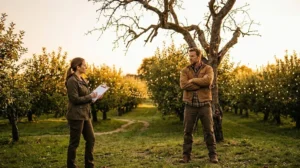
“You can’t put lights on that one,” Noah said, arms crossed, plaid sleeves rolled to the elbow, standing between Ava and a gnarled old apple tree like it was something worth defending.
“It’s an apple tree,” Ava said, pen still poised over her clipboard. “In an orchard. Where we are having an apple orchard wedding.”
“It’s not just an apple tree.” His jaw was tight in a way that told her this wasn’t about aesthetics. “That’s my dad’s tree. He planted it the year I was born. You can string lights on every other tree in this orchard. Not that one.”
Ava had learned, over six years of difficult fathers-of-the-bride and demanding mothers-in-law, that an immovable man standing in a field usually wasn’t being difficult for no reason. She lowered her clipboard.
“Okay,” she said simply. “Then we won’t.”
He blinked, like he’d braced for an argument he didn’t get.
“That’s it? Okay?”
“That’s it.” She studied him for a second, this broad-shouldered orchard owner who ran the place his family had farmed for three generations, who had so far treated every one of her decorating choices like a personal insult. “You’ve fought me on the arbor placement, the seating chart, and now a tree. There’s a reason. I’d rather know it than keep guessing wrong.”
Something in his face shifted, the fight going out of it all at once, replaced by something tireder and sadder.
“My dad died eight months ago,” Noah said. “This is the last harvest before we sell the land. My brother’s wedding is the last thing that’s ever going to happen here that matters. I just don’t want it to look like a stranger’s party. I want it to still look like ours.”
Ava set her clipboard down on a nearby crate, because some conversations didn’t belong behind a checklist.
“Then let’s make sure it does,” she said.
What the Orchard Remembered
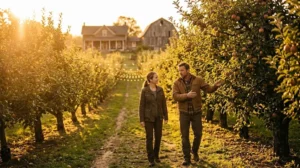
Over the next three weeks, Ava did something she’d never done for a client before. She stopped planning the wedding as an event and started planning it as a tribute.
She asked Noah to walk her through the orchard, tree by tree, and tell her what each one meant. It took two full afternoons. The row along the eastern fence, his father had planted the autumn his mother got pregnant with Noah’s sister. The crooked tree near the old barn had been struck by lightning once and somehow survived, which his father used to point to every storm season and say, see, some things just don’t know how to quit. The tallest tree in the whole orchard, right at the center, had been there before any of them, older than the farmhouse, older than the fences, and his father used to say it was the one tree that had seen everything the land had ever been.
Noah talked more in those two afternoons than Ava suspected he’d talked to anyone in eight months. He’d clearly been carrying all of it alone, the grief and the land and the coming sale, with no one to hand any of it to.
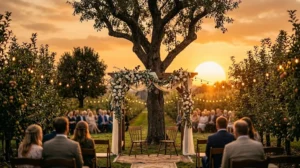
Ava redesigned the whole wedding around what she learned. The ceremony arbor moved to stand beneath the oldest tree in the center of the orchard, the one that had seen everything. The reception tables ran in a long line down the eastern row, where his mother had once walked heavy with his sister and his father had walked beside her. And instead of generic string lights strung at random, she had them wound carefully along every tree except one, his father’s tree, which she left bare and unadorned on purpose, a quiet, deliberate space in the middle of all that light.
“Why leave that one dark?” Noah asked, the day she showed him the final layout.
“Because some things don’t need decorating to matter,” Ava said. “They just need to be left alone and seen for what they already are.”
Noah didn’t say anything for a long moment. When he finally spoke, his voice had gone rough.
“You redesigned my family’s last season here like you actually knew them.”
“I didn’t,” Ava said softly. “You told me. I just listened.”
He looked at her the way a man looks at someone who has handed him back something he thought he’d lost for good.
The Thing About Selling
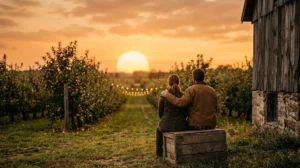
The closer the wedding got, the more time Ava found herself spending at the orchard, long past what any contract required. She told herself it was about getting the details right. She stopped quite believing that somewhere around the third sunset she stayed to watch with him, sitting on an overturned crate near the barn, saying very little, needing to say even less.
“You could keep it, you know,” she said one evening, watching the light go gold and heavy over the rows. “The land. You don’t have to sell.”
Noah shook his head, slow and tired. “The orchard doesn’t turn enough profit anymore to keep three siblings paid out of an inheritance. My brother needs his share for the wedding and the house they’re buying after. My sister needs hers for her shop. I can’t ask them to leave money in the ground because I’m sentimental about some trees.”
“That’s not sentimental,” Ava said. “That’s grief with nowhere to go. There’s a difference.”
He turned to look at her then, really look, the way he hadn’t let himself look at anyone in eight months of carrying everything alone.
“You keep doing that,” he said.
“Doing what?”
“Saying the thing I didn’t know how to say about myself.”
Ava felt her chest go warm and full in a way she hadn’t expected to feel on a job. She’d planned forty-one weddings and never once fallen for the family. She was fairly certain she was failing at that particular professional boundary right now, sitting on a crate in the dying light with a man who looked at an orchard like it was a person he was about to lose.
“For what it’s worth,” she said quietly, “I don’t think this land wants to be sold. I think it wants someone to love it enough to stay.”
“That someone would need a reason to stay that isn’t just stubbornness,” Noah said.
“Maybe the wedding will show everyone a reason,” Ava said. “Maybe it already has.”
One Last Harvest
The wedding came on a gold October afternoon, the kind Sonoma County seemed to save for exactly this purpose, warm light slanting low through the rows, the whole orchard smelling of ripe apples and cut grass.
Noah’s brother said his vows beneath the oldest tree, the one that had seen everything, and when Ava looked up from her clipboard to check the timing, she saw Noah standing at the edge of the ceremony, not watching the couple, but looking out at the unlit tree near the barn, his father’s tree, dark and simple among all that borrowed light.
After the ceremony, as the reception swelled with music and the long tables filled under the string lights, Noah found Ava near the gift table, where she was doing the quiet, invisible work no guest ever noticed.
“My mother cried under that arbor,” he said. “My sister said it felt like Dad walked her partway down the aisle, in a way. Everyone keeps telling me the orchard felt like itself today, for the first time since he died.”
“It is itself,” Ava said. “You just finally let someone help you remember how to see it that way.”
Noah reached into his jacket pocket and pulled out a folded piece of paper, worn soft at the creases like it had been carried for days.
“I talked to my brother and sister this morning,” he said. “Before the ceremony. I told them I want to buy them out instead of selling the land outright. I’ve got a loan I can manage if I take on a wedding-venue business alongside the orchard. People clearly want to get married here.” He glanced at her, something hopeful and uncertain in it. “I’d need someone who actually knows how to run weddings. Someone who already knows every tree by name and what it means.”
Ava’s breath caught somewhere between her heart and her throat.
“Are you offering me a job, or something else?” she asked, only half teasing.
“Honestly,” Noah said, “I was hoping it could be both. Starting with dinner. Not a wedding dinner. Just ours.”
Ava looked around at the orchard, gold and warm and full of music, at the one dark tree standing quiet and whole in the middle of all that borrowed light, and felt something settle into place that had been missing since long before she ever stood in this orchard.
“I think your dad’s tree would like that,” she said, smiling. “And so would I.”
Noah laughed, surprised and bright, the sound of a man who’d finally put something heavy down.
“Then I guess,” he said, reaching for her hand, “we’re keeping the orchard. All of it.”
Behind them, the party carried on into the gold evening, string lights glowing in every row but one, the land full of music it hadn’t heard in far too long, finally, fully, home again.
About the Place in This Story
Sonoma County’s apple orchards are real, and many of them really do host weddings among the trees, the same way Ava’s did in this story. If you ever want to see the real thing, the Sonoma County Tourism official site is a good place to start planning a visit.
More Sweet Love Stories to Read Next
If this one left you smiling, these will too:
- The Bookshop on Charing Cross Road is a slow-burn happy ending love story set in a London bookshop.
- Ten Minutes at Pike Place is a cute love story told in weekly notes at a Seattle flower stall.
- 5 Short Romantic Stories to Read Tonight has more love stories you can finish in one sitting.