
Some of the best cute love stories don’t happen over months. They happen in ten minutes a week, fifty-two times a year, between a florist who talks too much and a stranger who never says enough. This is one of those stories — set at a real flower stall in Seattle, built out of sunflowers and silence, and it ends exactly the way you want it to.
If you’re after a sweet love story with a happy ending, get comfortable. This one is worth the wait.
One Bunch, Please
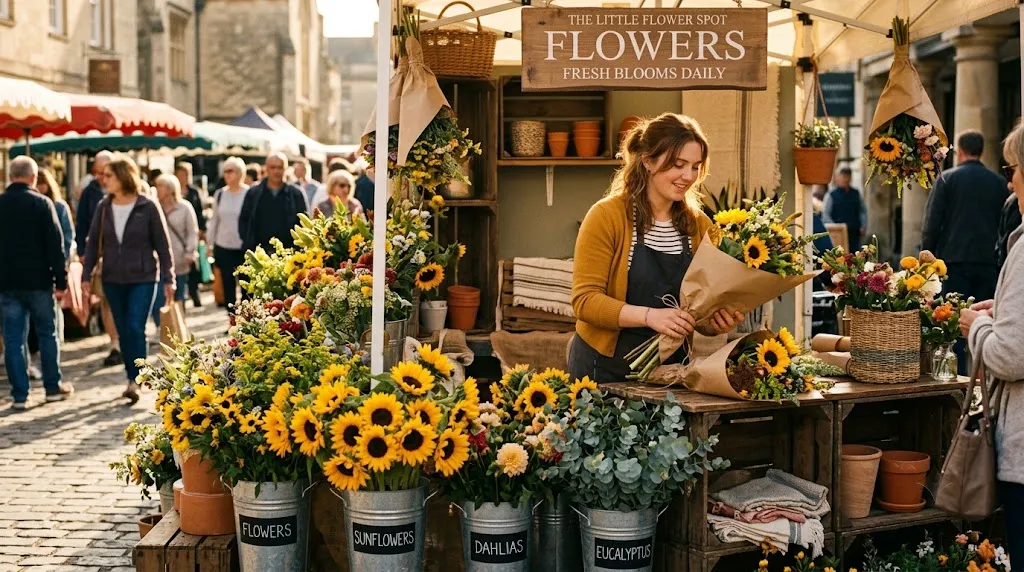
Rosie had worked the flower stall at Pike Place Market for six years, and in that time she’d learned to read a regular customer the way other people read the weather.
Old Mrs. Halloran always wanted whatever was cheapest and wilting a little, because she said flowers that had already survived something bloomed the longest once they got home. The Tuesday office crowd wanted anything bright enough to apologize with. The Saturday morning couples wanted whatever matched the color of their coffee cups.
And then there was him.
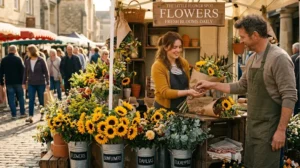
Every Saturday, nine o’clock sharp, rain or shine, a man in a dark green apron from somewhere nearby came to her stall, looked at the sunflowers like they owed him money, and said the same four words.
“One bunch, please.”
That was it. No good morning. No small talk about the weather rolling in off the Sound. He’d hand over exact change, take the flowers, and disappear back into the market crowd before Rosie could even say you’re welcome.
Six months of Saturdays. Six months of the same four words.
Rosie had names for half the regulars at Pike Place. Mrs. Halloran. The Tuesday crowd. The coffee-cup couples. She’d started calling him Sunflower Guy in her head, mostly because she didn’t have anything better, and partly because she’d begun, despite every instinct telling her not to, looking forward to nine o’clock more than she wanted to admit.
The Note in the Stems
It started as a joke, if she was honest with herself.
One Saturday, wrapping his usual bunch in brown paper, she tucked a small folded note between two stems, right where he’d find it when he unwrapped them. All it said was: These flowers deserve better conversation than “one bunch, please.” — R
She handed them over with her heart doing something embarrassing in her chest, and watched him walk off into the crowd without so much as a glance down at the bundle in his hand.
She figured that was that. A silly thing, forgotten by lunchtime.
The next Saturday, he set his exact change on the counter, same as always, and said, “One bunch, please.” Rosie’s stomach sank a little. She wrapped the flowers, quieter than usual, and didn’t tuck anything inside.
He paused. Actually paused, for the first time in six months, instead of walking straight off.
“You didn’t leave anything this time,” he said.
Rosie looked up so fast she nearly dropped the shears.
“You read it?”
“Six times,” he admitted, and something about the way he said it, a little embarrassed, a little pleased, cracked the careful silence they’d been keeping for half a year. “I didn’t know what to say back. I still don’t. But I kept it. It’s in my wallet.”
Rosie felt her whole face go warm.
“Well,” she said, reaching for a fresh sheet of brown paper before she’d fully thought it through, “I suppose I’ll have to give you something to say back to, then.”
What He Never Said
She learned his name three Saturdays later. Noah.
She learned, in careful pieces, folded into brown paper along with the sunflowers, that he was a chef two blocks from the market, that he bought the flowers every week for the restaurant’s tables, that he’d once dated a market regular and it had ended badly enough that half the vendors still gave him a cool nod instead of a smile, which was why he kept his head down and his mouth shut every Saturday, four words and nothing more, because it was safer than being talked about again.
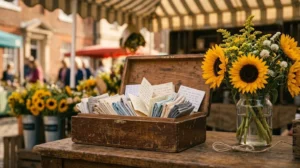
He never said all of that at once. It came out over weeks, a line at a time, written on napkins from his restaurant and tucked into her notes in return. Rosie started keeping every one of them in an old cigar box under her register, until the box was fuller than she liked to admit to herself.
I burned the first dish I ever cooked for someone I liked. I haven’t cooked for anyone since. — N
The sunflowers are the only thing on our tables that don’t judge me. — N
I think you already know I look forward to Saturdays more than I should. — N
That last one sat in Rosie’s apron pocket for three days before she worked up the nerve to write back.
I think I might too.
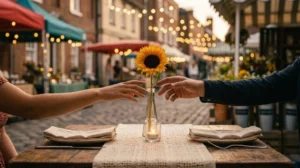
Table for Two
The Saturday before Thanksgiving, the market was louder than usual, crowded with tourists and the smell of roasting chestnuts drifting over from a cart two stalls down. Rosie had her hands full of ribbon and stems when Noah walked up, nine o’clock sharp, same as always.
But he didn’t say his four words.
He stood there a moment, hands in the pockets of his dark green apron, looking at her the way she imagined he looked at a dish right before it came together, careful, a little nervous, hoping.
“I don’t have any notes left to give you,” he said. “I used the last one two weeks ago.”
“I noticed,” Rosie said softly. “I was starting to think you’d run out of things to say.”
“I ran out of paper,” he said. “Not things to say. I’ve just been working up the courage to say the next thing out loud instead.”
Rosie set down her shears. The market noise seemed to fall back, just a little, the way a room does right before something important happens in it.
“Table for two,” Noah said. “Tonight. On the house. If you’re free.”
Rosie felt the warmth spread all the way up from her chest into her face, the kind of warmth that had nothing to do with the coffee cart steam curling past them.
“I close up at six,” she said.
“I’ll hold your table till seven,” he said, and for the first time in six months, he smiled at her, really smiled, the kind that changed his whole face.
That evening, Rosie showed up at his restaurant still in her market apron, hair smelling faintly of stems and rainwater, a single sunflower tucked behind one ear because she hadn’t had time to change and hadn’t wanted to anyway.
Noah came out from the kitchen the moment she walked in, untying his apron as he crossed the floor, like he couldn’t get to her fast enough.
“You kept the flower,” he said, nodding at the sunflower behind her ear.
“You kept the notes,” Rosie said back.
“Every single one.” He pulled out her chair himself, which made the hostess nearby smile in a way that said she’d clearly been waiting months for this to happen too. “I have a confession. I’ve been planning tonight’s menu around your favorite colors since October.”
Rosie laughed, the warm, surprised kind of laugh that came from somewhere she hadn’t used in a while. “You don’t even know my favorite color.”
“Yellow,” Noah said, without missing a beat. “Like the sunflowers. I’ve been paying attention.”
She looked at him across the small candlelit table, this quiet man who’d needed six months and a cigar box full of napkins to say what he meant, and felt something settle into place that had been waiting a long time to land.
“Well,” Rosie said, “for a man who only ever said four words to me, you certainly have a lot to say now.”
“I’ve got a whole year of Saturdays to make up for,” Noah said, reaching across the table for her hand. “I plan on using every single one.”
Outside, the market lights blinked on against the early dark, and somewhere beneath them, Rosie’s flower stall sat closed and quiet for the night, sunflowers waiting for Monday, while the two people who’d found each other one ten-minute Saturday at a time finally had all the time in the world to talk.
About the Place in This Story
Pike Place Market is real, and it’s still Seattle’s beating heart, flower stalls and all. Vendors have sold fresh blooms there since the market opened in 1907, and the sunflowers Rosie sells are one of its most photographed sights.
If you’re ever in Seattle, you can visit the market yourself through the Pike Place Market official website.
More Sweet Love Stories to Read Next
If this one left you smiling, these will too:
- The Bookshop on Charing Cross Road is another slow-burn love story with a happy ending, set in a London bookshop.
- 5 Short Romantic Stories to Read Tonight has more love stories you can finish in one sitting.
- 3 Free Short Bedtime Stories for Adults is perfect for one more story before you sleep.