

The parcel came exactly one year after Kabir disappeared inside Bhangarh Fort.
It was a small wooden box with no sender’s name on it. Meera almost threw it away. Then she saw the handwriting on the lid, and her hands went cold.
She knew that handwriting. Kabir always wrote the letter M like two small mountains. He did it on birthday cards, on shopping lists, and on the little notes he stuck on the fridge. He did it on the last note he ever left her too: Back on Sunday. Keep the chai warm.
He never came back on Sunday.
Inside the box was a tiny glass bottle, no bigger than her thumb. It was full of dark golden oil and sealed with old red wax. Under it was a folded piece of paper.
Come before the sun goes down. Don’t open it.
She read it again and again. Then she held the bottle close to her nose. Even through the wax, she could smell it. Roses. Sandalwood. And something older underneath, like dust after rain.
It was attar, a very old and very expensive one.
That was the strange part. Kabir hated perfume. Even a little rose water gave him a headache. In four years together, he had never bought her a single bottle.
A year ago, Kabir had gone to Rajasthan to photograph Bhangarh Fort for his book about forgotten places. People called it the most haunted place in India. Kabir only laughed. “Ghosts don’t need permission from the government,” he said. “But I do.”
He went anyway, and he stayed after sunset.
The police found his car outside the main gate. They found his camera bag on the steps of an old temple inside the ruins. They never found him.
The last photo on his memory card was taken at 8:41 PM. It showed the old market street of Bhangarh. But in the photo, the broken shops had roofs. Oil lamps were burning in every doorway. And the street was full of people.
The police said the camera was faulty. Meera’s mother said it was time to move on. Meera said nothing. She kept the photo as her phone wallpaper, and she waited.
Now she had more than waiting. She had a bottle, a note, and a place to go.
The Road to Bhangarh Fort
She took the early bus from Jaipur. From the last town, she hired a local jeep. The driver was an old man called Ghanshyam, and he talked the whole way.
“You know the story of the princess?” he asked, watching her in the mirror.
“A little.”
“Princess Ratnavati. So beautiful that kings from far away sent marriage proposals. But one man wanted her more than all of them. A tantric. A man who knew black magic. Singhia was his name.”
The road turned dusty. Dry brown hills rose on both sides.
“One day, the princess’s maid went to the market to buy perfume oil for her. The tantric saw it. He put a spell on the oil. Whoever wore it would walk straight to him and love him forever.”
“What happened?”
“The princess was clever. She saw the magic in it. She did not wear it. She poured it on a big rock.” He smiled. “The rock started to roll. It rolled all the way to the tantric’s house on the hill, and it crushed him.”
Meera looked out of the window.
“Before he died,” Ghanshyam said, “he cursed the whole city. Everyone in Bhangarh would die, and their souls would never rest. Soon after, a war came. The princess died too. The city was empty in one night.”
He was quiet for a moment.
“My grandmother used to say one more thing. She said the city still waits every night. For the princess. So the tantric can try again.”
He dropped her at the gate a little after four. A blue government board stood near the entrance. Among other rules, it said in big letters that entry before sunrise and after sunset was strictly not allowed.
An old guard with a white moustache sat under a tree with a wooden stick across his knees.
“The whistle goes at five-thirty,” he told her. “At six, I lock the gate. Whoever is inside stays inside. I don’t come to look for them.”
“Has anyone ever stayed?”
He looked at her for longer than he needed to.
“Last year. A photographer.”
Meera’s heart jumped. “Did you see him leave?”
“Nobody sees anybody leave, bitiya.”
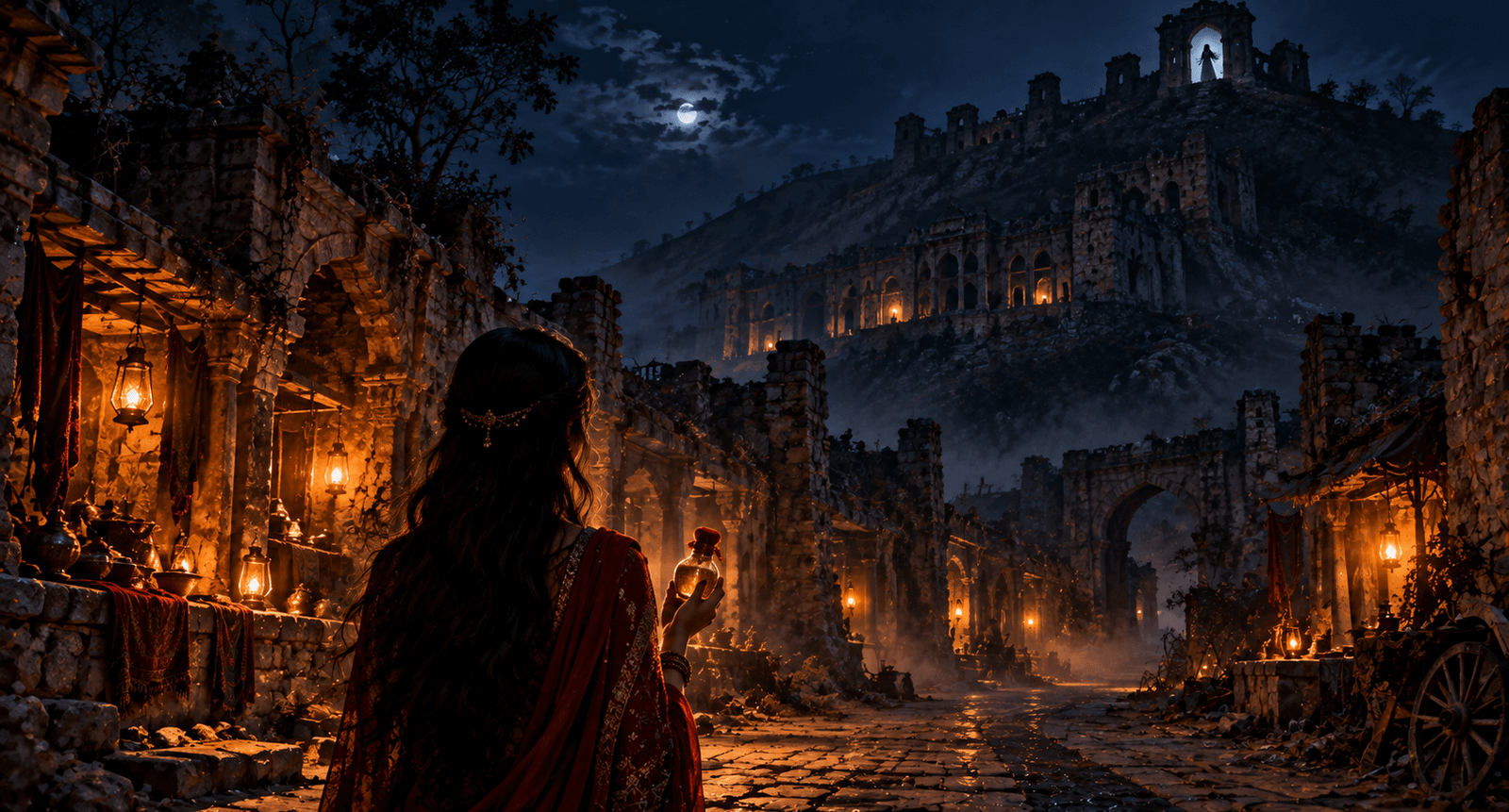
Inside, the ruins were quiet and golden in the afternoon light. Monkeys sat on the broken walls. Big banyan trees grew between the stones. The old market street ran straight ahead, with rows of small stone shops on both sides. None of them had roofs anymore.
At the end of the street, the palace climbed up the side of the hill. Above the palace, right at the top, stood a small broken stone building. Ghanshyam had pointed at it from the jeep. That was the tantric’s place, he had said.
Meera found the temple steps where Kabir’s bag had been found. She sat there and watched the tourists take selfies and slowly leave.
At five-thirty, the whistle blew.
She hid inside one of the broken shops, behind a wall, with her knees pulled up to her chest. She heard the guard’s slow footsteps pass. Then came the heavy sound of the iron gate closing.
The sun went down behind the hills.
Night Falls on Bhangarh Fort
First, the monkeys went quiet. Then the birds. Then even the wind stopped.
Then Meera smelled it. Roses. Sandalwood. Dust after rain.
She touched her pocket. The bottle was still there. The wax was not broken.
A light came on outside. Then another. Then a hundred more.
She stood up slowly and stepped into the street.
The shop behind her had a roof. Its wooden doors were painted green. A man was selling glass bangles from a cloth on the ground. Somewhere, jalebis were frying in hot oil. Children ran past, laughing. Women walked by in bright red and yellow odhnis. And from the palace came the slow beat of a dhol, like a heartbeat.
Nobody looked surprised to see her. They stepped aside to let her pass. An old woman bent down and touched her feet.
“Rajkumari ji has come,” she whispered.
Meera looked down at herself. Old jeans. Dusty sneakers. But everyone was bowing as if she was wearing gold.
She walked, because she didn’t know what else to do. The street led her to the palace. At the bottom of the palace steps stood a man in a blue shirt with a camera around his neck.
“Kabir.”
She ran, and he caught her. He was warm. He smelled of sun and dust, exactly like always. She cried into his shoulder, and he laughed softly into her hair, the way he did when she cried at sad movies.
“You came,” he said.
“Where were you? A whole year, Kabir!”
“A year?” He looked confused. “It’s been one night. One long night. Every time I walk to the gate, it isn’t there. The road just turns back to the market.”
He held her face in both hands. “But you’re here now. We can go home.”
“Then let’s go. Right now.”
“Not like this.” His eyes moved to her pocket. “Did you bring it?”
She took out the bottle. The red wax shone in the lamplight.
“Put a little on your wrist,” he said gently. “Just a little. Then the gate will open for both of us. That’s the rule here. I’m sorry. I didn’t make the rules.”
She almost did it. Her thumb was already on the wax.
Then a small girl with a basket of marigolds pulled at her sleeve.
“Everyone is so happy, Rajkumari ji,” the girl whispered. “Now the story can finish.”
“What story?”
The girl only smiled and ran off down the street. She ran right past a big burning lamp.
Her body threw no shadow on the ground.
Meera looked around slowly. Hundreds of lamps. Hundreds of people. Not one shadow on the stones. Not the bangle seller’s. Not the old woman’s.
Not Kabir’s.
There was only one shadow in the whole street. It was long and dark and stretched back towards the market. It was hers.
She looked down at the bottle. She thought about a man who hated perfume, and who was now begging her to wear some.
“Kabir,” she said quietly. “Who told you to write that note?”
His smile slipped. For a moment he looked very, very tired. He didn’t answer. He only lifted his eyes to the top of the hill.
Someone was sitting in the small broken stone building above the palace. It was a thin dark figure, perfectly still, watching them.
“He said if you came, I could keep you,” Kabir whispered. “Every night, Meera. We would be together every night. I heard you crying for a whole year. I thought this was better than nothing.”