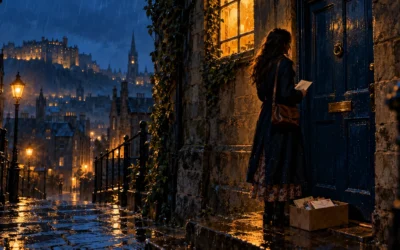

The last time Meera saw Arjun, she did not say goodbye. She just left a note on his pillow and got into a taxi before the sun came up. Ten years later, she was standing outside his house again, holding the same kind of silence in her chest, waiting to see if her hand could still knock on that door.
It could. Three soft knocks. Nothing dramatic. Just enough to make her heart feel like it was climbing up her throat.
A woman opened the door. Young, pretty, wearing a simple cotton kurta, looking at Meera the way you look at someone you don’t recognize but somehow feel you should.
“Yes? Can I help you?”
“I’m… looking for Arjun,” Meera said. “We used to know each other. A long time ago.”
Something flickered in the woman’s eyes. Not jealousy. Something softer, almost like relief.
“He’s not home right now. He’s at the old workshop, behind the railway station. He still goes there most evenings.” She paused. “You’re Meera, aren’t you?”
Meera’s breath caught. “How do you know my name?”
The woman smiled, a small, tired smile. “He says it in his sleep sometimes.”

Finding Arjun at the Workshop
That sentence followed Meera all the way to the railway station, sitting in her chest like a stone she couldn’t put down.
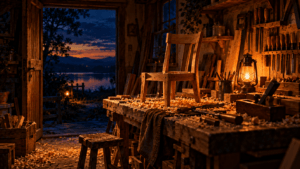
The workshop hadn’t changed. Same rusted tin roof, same smell of wood shavings and old paint. Arjun was there, sanding down a chair leg, sleeves rolled up, his hair a little grayer at the sides than she remembered. Ten years had touched him gently. Ten years had touched her differently.
He looked up like he already knew someone was standing there. And when he saw her, he didn’t drop the sandpaper. He didn’t gasp. He just stood very still, like a man who had imagined this moment so many times that the real one didn’t feel real at all.
“Meera.”
“Hi, Arjun.”
Neither of them moved for a long moment. Ten years is a strange thing. It’s long enough to forget a face, but she hadn’t forgotten a single line of his.
“You look…” he started, then stopped, because there wasn’t a safe way to finish that sentence.
“I know I have no right to be here,” she said quickly, the words falling out before she lost her nerve. “I just needed to see you. Once. Then I’ll go.”
He set the sandpaper down slowly. “Ten years, and that’s what you came here for? To see me and go?”
“I didn’t know what else to do.”
“You could have called. Written a letter. Anything. Instead you just disappeared, Meera. One day you were there, and the next, gone. No number. No address. Nothing.” His voice wasn’t loud, but it had an edge to it, an old wound that had never quite closed. “Do you know what that did to me?”
“I know,” she whispered. “I know, and I’m sorry. I don’t expect you to forgive me.”
He looked at her for a long time, like he was trying to decide something. Then he wiped his hands on a cloth and said, “Walk with me.”
The Truth About Priya
They ended up at the small tea stall near the river, the same one where they used to sit as teenagers, sharing one cup of chai because neither of them had enough money for two. The owner had changed, but the wooden benches were the same, worn smooth by years of people sitting exactly where they were sitting now.
“Your wife,” Meera said carefully. “She seems kind.”
Arjun let out a breath that was almost a laugh, but not quite. “Priya. Yes. She is kind. Too kind, probably, for what she agreed to.”
“What do you mean?”
He turned his cup in his hands, not looking at her. “It’s not really a marriage, Meera. Not in the way you think. My mother was dying two years ago. Her last wish was to see me married. Priya’s family needed help, my family had some money saved. It was… an arrangement. We live in the same house. We are kind to each other. But there is nothing else. She knows it. I know it. We both agreed to it with our eyes open.”
Meera felt something in her chest crack open, though she couldn’t yet name if it was hope or grief.
“Why are you telling me this?”
“Because you came all this way,” he said, finally looking at her, “and I am done pretending I don’t still think about you every single day.”
They talked until the tea stall closed. Then they kept talking, walking along the river, past the old cinema hall that used to show one film a week, past the school where they had first held hands under a desk during an exam neither of them studied for. Every street held a memory, and every memory made it harder for Meera to remember why she had ever left.
“Do you remember the letter you used to write me?” Arjun asked, as they sat on the steps near the temple, the night air cool around them. “Every week, even though we lived five minutes apart.”
“I remember all of them,” Meera said. “I still have yours. Every single one.”
“Then why,” he asked quietly, “did the letters just stop? No fight. No warning. You just vanished.”

Why She Really Left
This was the question she had been dreading since she stepped off the train that morning. She looked at the water instead of at him.
“I found out I was sick, Arjun. Really sick. The kind of sick where doctors start talking in careful voices and won’t look you in the eye.”
He went very still.
“They gave me maybe two years, if I was lucky. I thought about telling you. I really did. But I kept picturing your face, watching me get thinner, weaker, watching me disappear a little more every single day. I didn’t want you to remember me like that. I wanted you to remember me laughing at your terrible jokes, not lying in a hospital bed. So I left. I told myself it was the kindest thing I could do for you.”
“You decided that for both of us,” he said, his voice shaking now. “You didn’t even give me the choice.”
“I know. I was wrong. I know that now.” Her eyes filled, but she kept talking, because if she stopped, she might never finish. “I went to my aunt’s place in another city. I did the treatment alone. It was hell, Arjun. I won’t lie to you. There were nights I prayed to just stop breathing so it would be over. But I didn’t stop breathing. I got better. Slowly, then completely. The doctors still don’t fully understand why I survived when the numbers said I shouldn’t have.”
“And you never once thought to come back and tell me you were alive?”
“I was ashamed,” she admitted. “Of leaving the way I did. And then, the longer I stayed away, the harder it became to imagine facing you. I told myself you had probably moved on, married, had a life without me in it. It felt easier to stay a ghost than to come back and find out I really had lost you.”
They sat in silence after that, the kind of silence that says more than words ever could. Arjun reached over, slowly, and took her hand, the way he used to when they were young and everything still felt possible.
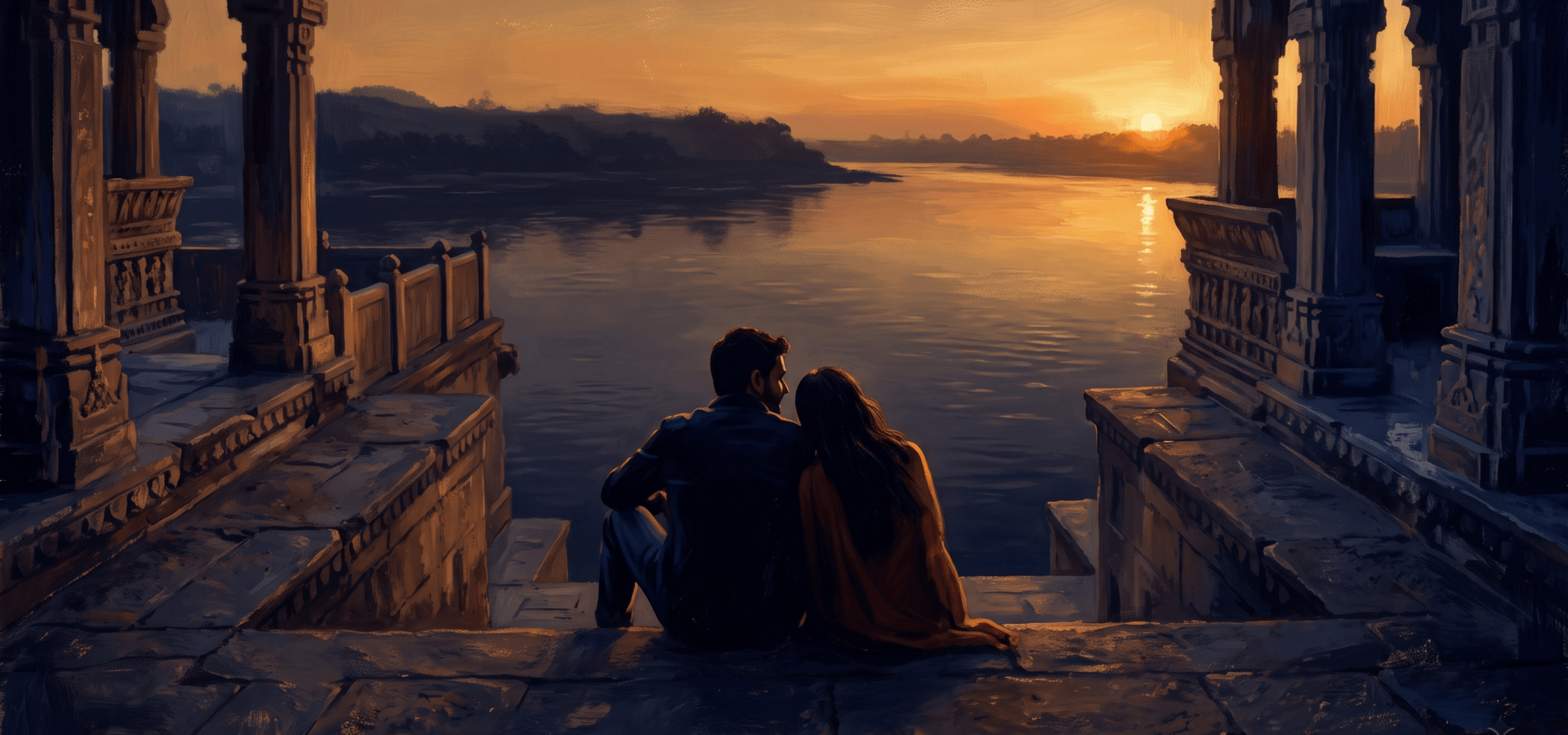
They spent the whole night on those temple steps, talking about everything they had lost and everything they might still have. He told her about the years he spent hoping his phone would ring with her number. She told him about the hospital room where she used to whisper his name just to remember what hope sounded like. By the time the sky began to turn a soft gray, they were sitting close, foreheads almost touching, both of them finally saying the things ten years of silence had buried.
One Night Isn’t Enough
“Stay,” he said, as the first light touched the river. “Don’t disappear again. Please.”
Meera opened her mouth to answer, and that was when the pain hit her, sharp and sudden, right behind her ribs, the same pain the doctors had warned her about only last month, in a conversation she never told anyone. She pressed her hand against her chest and tried to smile through it, tried to make it look like nothing.
“Meera?”
“I’m fine,” she said, though her voice betrayed her. “I’m fine, Arjun.”
But she wasn’t. The illness had never fully left her body. It had only slept, quietly, waiting. The doctors had found it again three months ago, deeper this time, harder to fight. She had come back not to start a new life with him, but to say goodbye properly, the way she should have the first time. She just hadn’t found the courage to say it out loud yet.
As the sun rose fully over the river, turning the water gold, Arjun held her hand tightly, still smiling, still hopeful, still believing this was a beginning.
Meera smiled back at him, memorizing his face one more time, and said nothing at all about the truth she now had to carry alone, again, for however many mornings she had left.
If endings like this stay with you, you’ll find more short love stories on Dark Hour Stories, including more bittersweet romance written to break your heart a little.”